| MOQ: | 1,000pcs |
| Price: | negotiation |
| Standard Packaging: | Packed in plastic bag, then in carton with standard export package |
| Delivery Period: | one week for new samples |
| Payment Method: | T/T,Western Union,L/C |
| Supply Capacity: | 100,000pcs per month |
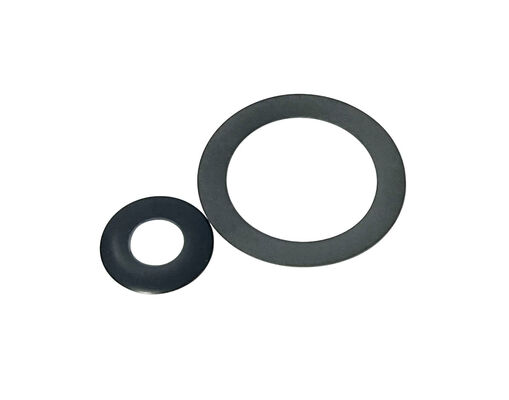
Engineered for low-friction piston sealing in automotive damper applications, this MoS2 (molybdenum disulfide) filled PTFE gasket ring combines the self-lubricating properties of PTFE with enhanced friction-reduction from MoS2 filler. Produced through a meticulously controlled 13-hour sintering cycle followed by precision CNC machining, it delivers the dimensional accuracy and surface finish required for high-performance damper piston assemblies.
Addressing Your Application ChallengesUltra-Low Friction Requirements in High-Cycle Dampers: Modern automotive dampers can exceed 10 million cycles over vehicle lifetime. Standard seal materials generate progressive friction increases as surface asperities develop. MoS2 filler creates a transfer film on mating surfaces that actively reduces friction coefficient, maintaining consistent damping characteristics throughout the damper's entire service life.
Aggressive Chemical Media Sealing: Dampers operating in chemical processing, oil exploration, or sanitary environments expose piston seals to aggressive acids, alkalis, and solvents. Our filled PTFE gasket provides sealing integrity across the full pH 0-14 range, withstanding conditions that would rapidly degrade elastomeric alternatives.
Sintering Process Inconsistency: Rushed or uneven sintering produces internal stresses, porosity, and inconsistent mechanical properties that manifest as premature field failures. Our 13-hour computer-controlled sintering profile ensures complete particle fusion, stress relief, and uniform crystallinity — producing homogeneous material properties throughout every gasket.
Precision Tolerance on Thin-Wall Rings: Achieving tight OD and ID tolerances on thin-section PTFE rings (D32xD15x0.60mm) is technically challenging due to material compliance. Our CNC machining with specialized workholding and optimized cutting parameters delivers precision tolerances that ensure consistent piston-to-cylinder clearance control.
High-Purity Application Requirements: Semiconductor, pharmaceutical, and food-grade damper applications demand seal materials with no leachable contaminants. Virgin and filled PTFE grades offer exceptional purity with no plasticizers, curing agents, or volatile compounds that could contaminate process fluids.
| properties | unit | result |
| Apparent density | g/cm3 | 2.10-2.30 |
| Tensile strength(min) | MPa | 15.0 |
| Ultimate elongation(min) | % | 150 |
| Working Temp. | degC | -180~260 |
| Melting point | degC | 327 |
| Produce Max Temp. | degC | 385 |
| Size | mm | 20mm~400mm |
1. Low water absorption
2. Corrosion resistance
3. Temperature resistance
Filled PTFE gasket used in shock piston, precision tolerance on OD and ID
Material: PTFE filled with carbon fiber
Size: D32XD15X0.60
Style: seal gasket
Shape: can be customized
Package detail: poly bag + carton box
Delivery time: 10 days
Payment terms: T/T, LC and others
Use temperature: -100~250 degC
Use pressure: 5Mpa
| inspection item | Unit | Data |
| Bulk density | g/cm3 | 1.90(+-0.10)-for sheet; 2.30(+-0.20) for PTFE seal |
| Pressure Limit | Bar | 40 |
| Temperature Limit | 260 | |
| PH Range | 0-14 | |
| PTFE Seal thickness | MM | 0.5(+-0.10)/side |
| Gasket Thickness | MM | 2(+-0.10) or as customers' request |
It is widely used as flange sealing to joint where strong acid or alkaline or other corrosive media exist or high purity is required.
1. Good quality: We have strict quality control system. Good reputation in the market
2. Quality Control: Approved by GB/T 19001-2008/ ISO9001:2008
3. Fast and cheap delivery: We have big discount from forwarder(Long Contract)
4. Can produce according to customers' drawings
5. Advanced production equipment
6. Complete set of inspection equipment
Frequently Asked Questions Q1: What is the benefit of MoS2 (molybdenum disulfide) filler in PTFE piston rings?MoS2 is a solid lubricant that synergistically enhances PTFE's already low friction coefficient. It forms a molecular-level transfer film on the mating metal surface, reducing both static and dynamic friction. This is particularly valuable in damper applications where consistent breakaway force and smooth transition from static to dynamic motion are critical for ride quality. MoS2-filled PTFE typically achieves 10-15% lower friction than unfilled PTFE in lubricated conditions.
Q2: Why does your sintering process take 13 hours, and how does this affect quality?The 13-hour sintering cycle is an optimized multi-stage thermal profile that includes gradual heat-up to avoid thermal shock and internal stress formation, extended high-temperature dwell at 370-385degC for complete particle fusion, and controlled cooling to achieve optimal crystallinity (typically 50-65%). This extended cycle eliminates the porosity and incomplete fusion that plague shorter sintering processes, resulting in superior mechanical properties, dimensional stability, and wear resistance.
Q3: What tolerance can you hold on the D32xD15x0.60mm ring dimensions?Our CNC machining process achieves OD tolerance of +-0.03mm, ID tolerance of +-0.03mm, and thickness tolerance of +-0.03mm on the D32xD15x0.60 configuration. For production volumes, we conduct capability studies (Cpk analysis) and can provide statistical process control data. Tighter tolerances may be achievable through additional finishing operations.
Q4: Is this gasket suitable for high-purity or semiconductor industry applications?Yes. Our PTFE gaskets are widely used in applications requiring high purity and corrosion resistance. Virgin PTFE grades offer exceptional chemical purity with no extractable plasticizers, curing agents, or processing aids. For semiconductor applications requiring ultra-low extractable metals, we offer specially cleaned grades. Food-grade (FDA 21 CFR 177.1550) certification is available for virgin PTFE grades.
Q5: Can you provide both MoS2-filled and carbon fiber-filled versions?Yes. We maintain capability for multiple filler systems including carbon fiber, MoS2, glass fiber, bronze, graphite, and blended formulations. While this product listing highlights MoS2 filling for low-friction applications, we routinely produce the same geometry in alternative filler compounds based on customer requirements. Our application engineers can help select the optimal filler system for your operating conditions.
Q6: What is the pressure and temperature operating envelope for these gaskets?The gaskets are rated for continuous operation at pressures up to 5 MPa and temperatures from -100degC to 250degC in typical damper applications. The broader material capability extends to 40 Bar pressure limit and 260degC temperature limit per application data testing. For applications approaching these limits, we recommend providing detailed operating conditions for a formal application review and material recommendation.
| MOQ: | 1,000pcs |
| Price: | negotiation |
| Standard Packaging: | Packed in plastic bag, then in carton with standard export package |
| Delivery Period: | one week for new samples |
| Payment Method: | T/T,Western Union,L/C |
| Supply Capacity: | 100,000pcs per month |
Engineered for low-friction piston sealing in automotive damper applications, this MoS2 (molybdenum disulfide) filled PTFE gasket ring combines the self-lubricating properties of PTFE with enhanced friction-reduction from MoS2 filler. Produced through a meticulously controlled 13-hour sintering cycle followed by precision CNC machining, it delivers the dimensional accuracy and surface finish required for high-performance damper piston assemblies.
Addressing Your Application ChallengesUltra-Low Friction Requirements in High-Cycle Dampers: Modern automotive dampers can exceed 10 million cycles over vehicle lifetime. Standard seal materials generate progressive friction increases as surface asperities develop. MoS2 filler creates a transfer film on mating surfaces that actively reduces friction coefficient, maintaining consistent damping characteristics throughout the damper's entire service life.
Aggressive Chemical Media Sealing: Dampers operating in chemical processing, oil exploration, or sanitary environments expose piston seals to aggressive acids, alkalis, and solvents. Our filled PTFE gasket provides sealing integrity across the full pH 0-14 range, withstanding conditions that would rapidly degrade elastomeric alternatives.
Sintering Process Inconsistency: Rushed or uneven sintering produces internal stresses, porosity, and inconsistent mechanical properties that manifest as premature field failures. Our 13-hour computer-controlled sintering profile ensures complete particle fusion, stress relief, and uniform crystallinity — producing homogeneous material properties throughout every gasket.
Precision Tolerance on Thin-Wall Rings: Achieving tight OD and ID tolerances on thin-section PTFE rings (D32xD15x0.60mm) is technically challenging due to material compliance. Our CNC machining with specialized workholding and optimized cutting parameters delivers precision tolerances that ensure consistent piston-to-cylinder clearance control.
High-Purity Application Requirements: Semiconductor, pharmaceutical, and food-grade damper applications demand seal materials with no leachable contaminants. Virgin and filled PTFE grades offer exceptional purity with no plasticizers, curing agents, or volatile compounds that could contaminate process fluids.
| properties | unit | result |
| Apparent density | g/cm3 | 2.10-2.30 |
| Tensile strength(min) | MPa | 15.0 |
| Ultimate elongation(min) | % | 150 |
| Working Temp. | degC | -180~260 |
| Melting point | degC | 327 |
| Produce Max Temp. | degC | 385 |
| Size | mm | 20mm~400mm |
1. Low water absorption
2. Corrosion resistance
3. Temperature resistance
Filled PTFE gasket used in shock piston, precision tolerance on OD and ID
Material: PTFE filled with carbon fiber
Size: D32XD15X0.60
Style: seal gasket
Shape: can be customized
Package detail: poly bag + carton box
Delivery time: 10 days
Payment terms: T/T, LC and others
Use temperature: -100~250 degC
Use pressure: 5Mpa
| inspection item | Unit | Data |
| Bulk density | g/cm3 | 1.90(+-0.10)-for sheet; 2.30(+-0.20) for PTFE seal |
| Pressure Limit | Bar | 40 |
| Temperature Limit | 260 | |
| PH Range | 0-14 | |
| PTFE Seal thickness | MM | 0.5(+-0.10)/side |
| Gasket Thickness | MM | 2(+-0.10) or as customers' request |
It is widely used as flange sealing to joint where strong acid or alkaline or other corrosive media exist or high purity is required.
1. Good quality: We have strict quality control system. Good reputation in the market
2. Quality Control: Approved by GB/T 19001-2008/ ISO9001:2008
3. Fast and cheap delivery: We have big discount from forwarder(Long Contract)
4. Can produce according to customers' drawings
5. Advanced production equipment
6. Complete set of inspection equipment
Frequently Asked Questions Q1: What is the benefit of MoS2 (molybdenum disulfide) filler in PTFE piston rings?MoS2 is a solid lubricant that synergistically enhances PTFE's already low friction coefficient. It forms a molecular-level transfer film on the mating metal surface, reducing both static and dynamic friction. This is particularly valuable in damper applications where consistent breakaway force and smooth transition from static to dynamic motion are critical for ride quality. MoS2-filled PTFE typically achieves 10-15% lower friction than unfilled PTFE in lubricated conditions.
Q2: Why does your sintering process take 13 hours, and how does this affect quality?The 13-hour sintering cycle is an optimized multi-stage thermal profile that includes gradual heat-up to avoid thermal shock and internal stress formation, extended high-temperature dwell at 370-385degC for complete particle fusion, and controlled cooling to achieve optimal crystallinity (typically 50-65%). This extended cycle eliminates the porosity and incomplete fusion that plague shorter sintering processes, resulting in superior mechanical properties, dimensional stability, and wear resistance.
Q3: What tolerance can you hold on the D32xD15x0.60mm ring dimensions?Our CNC machining process achieves OD tolerance of +-0.03mm, ID tolerance of +-0.03mm, and thickness tolerance of +-0.03mm on the D32xD15x0.60 configuration. For production volumes, we conduct capability studies (Cpk analysis) and can provide statistical process control data. Tighter tolerances may be achievable through additional finishing operations.
Q4: Is this gasket suitable for high-purity or semiconductor industry applications?Yes. Our PTFE gaskets are widely used in applications requiring high purity and corrosion resistance. Virgin PTFE grades offer exceptional chemical purity with no extractable plasticizers, curing agents, or processing aids. For semiconductor applications requiring ultra-low extractable metals, we offer specially cleaned grades. Food-grade (FDA 21 CFR 177.1550) certification is available for virgin PTFE grades.
Q5: Can you provide both MoS2-filled and carbon fiber-filled versions?Yes. We maintain capability for multiple filler systems including carbon fiber, MoS2, glass fiber, bronze, graphite, and blended formulations. While this product listing highlights MoS2 filling for low-friction applications, we routinely produce the same geometry in alternative filler compounds based on customer requirements. Our application engineers can help select the optimal filler system for your operating conditions.
Q6: What is the pressure and temperature operating envelope for these gaskets?The gaskets are rated for continuous operation at pressures up to 5 MPa and temperatures from -100degC to 250degC in typical damper applications. The broader material capability extends to 40 Bar pressure limit and 260degC temperature limit per application data testing. For applications approaching these limits, we recommend providing detailed operating conditions for a formal application review and material recommendation.