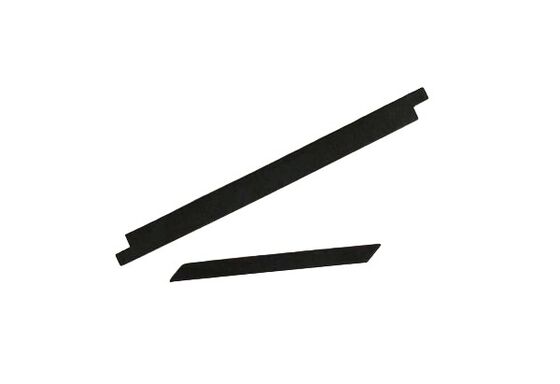
| MOQ: | 1,000pcs |
| Price: | Can be discussed |
| Standard Packaging: | Standard export package |
| Delivery Period: | Within two weeks |
| Payment Method: | L/C,T/T,D/A,D/P |
| Supply Capacity: | 100000pcs per month |
PTFE piston bands are engineered polymer strips designed for installation in the circumferential grooves of automotive and motorcycle shock absorber pistons. Once installed, the bands form a sliding contact interface between the piston and the inner wall of the working cylinder.
Unlike general-purpose PTFE sheets or sealing tapes, shock absorber PTFE bands require dimensions specifically matched to the piston groove geometry. Band width, thickness, developed length, and joint configuration all affect the fit between the piston and cylinder.
XIAYI supplies filled PTFE piston bands for shock absorber applications, including customized copper-powder-filled PTFE formulations according to project requirements. Band dimensions can be machined according to customer drawings and piston designs.
These products are intended for piston guiding and sliding applications in automotive dampers, motorcycle front forks, and rear shock absorbers.
PTFE band dimensions must be matched to the piston groove and the intended assembly conditions. The main design inputs include:
Piston groove width: determines the required band width.
Piston groove depth: helps determine band thickness and finished outside diameter.
Piston outside diameter: provides the basis for developed band length and assembly dimensions.
Cylinder inner diameter: used to assess piston-to-cylinder clearance.
Joint allowance and configuration: determine the developed length and end-machining requirements.
These dimensions should be reviewed together against the piston drawing. Selecting a band based on piston outside diameter alone is not sufficient.
XIAYI offers filled PTFE piston bands, including customized copper-powder-filled formulations.
By adjusting filler type and formulation ratio, material density, hardness, tensile properties, friction behavior, and wear characteristics can be evaluated for different applications.
For projects with specific friction or wear requirements, the compound specification should be confirmed before testing the material under the actual piston and cylinder conditions.
After installation, the PTFE band must form a joint configuration compatible with the piston groove.
Different piston designs may require different end-cut profiles. Joint design should consider developed band length, installation clearance, groove dimensions, and the final assembly diameter.
For volume production, sample evaluation should confirm the joint condition and finished outside diameter before approving the production specification.
The edge condition of PTFE bands can affect installation and joint fit. In addition to width and thickness, inspection should consider edge integrity, end geometry, and dimensional consistency between batches.
XIAYI can review machining specifications according to customer drawings and establish inspection requirements for the selected dimensions.
The following values are reference properties from existing filled PTFE product information. Actual performance of copper-filled formulations should be verified against the selected compound specification and batch test records.
Parameter |
Reference Data |
Technical Notes |
Product |
PTFE Piston Bands |
For shock absorber pistons |
Base material |
Filled PTFE |
Filled polytetrafluoroethylene |
Filler option |
Copper powder |
Content defined by customized formulation |
Appearance |
Black |
Subject to approved product sample |
Reference material density |
2.06–2.19 g/cm³ |
Existing filled PTFE product data |
Reference hardness |
Shore 57–61 |
Hardness scale to be confirmed in the approved material specification |
Tensile strength |
≥18 MPa |
Existing reference material data |
Elongation at break |
≥160% |
Existing reference material data |
Friction coefficient |
<0.2 |
Reference value; test conditions must be confirmed |
Wear loss |
<50 mg |
Reference value; test method must be confirmed |
Reference maximum working temperature |
260°C |
Existing material information; actual limit depends on formulation and service conditions |
Band width |
Customized according to drawing, mm |
Matched to piston groove width |
Band thickness |
Customized according to drawing, mm |
Matched to groove depth and finished diameter |
Developed band length |
Customized according to drawing, mm |
Based on piston circumference and joint design |
Joint configuration |
Customized according to drawing |
Defined by piston geometry and installation requirements |
Applications |
Automotive and motorcycle shock absorbers |
For piston sliding and guiding applications |
Material data note: Density, hardness, tensile strength, elongation, friction coefficient, and wear loss are reference values from existing filled PTFE product information. They should not be assumed to apply to every copper-filled compound. The reference temperature of 260°C should also not be treated as the continuous operating temperature of a complete shock absorber assembly. Final specifications must be confirmed against the selected compound and actual test reports.
PTFE piston band quality should be evaluated through both material properties and dimensional machining accuracy.
Inspection Item |
Inspection Content |
Main Control Objective |
Material density |
g/cm³ |
Verify material batch specification |
Material hardness |
Agreed hardness scale |
Confirm compliance with the approved compound |
Tensile properties |
MPa and % |
Check tensile strength and elongation |
Band width |
mm |
Match piston groove width |
Band thickness |
mm |
Match groove depth and final diameter |
Developed length |
mm |
Meet piston circumference and joint requirements |
Edge quality |
Edge integrity and burrs |
Reduce machining-related assembly issues |
Joint dimensions |
End profile and joint condition |
Meet the assembly design |
Finished piston diameter |
mm |
Confirm piston-to-cylinder fit |
Band retention force |
N |
Evaluate the retention of the banded assembly using an agreed test method |
PTFE material testing and complete banded piston durability testing should be evaluated separately.
Existing XIAYI banded piston product information records the following reference validation items:
Test Item |
Recorded Condition or Data |
Stress cracking test |
150°C × 500 hours |
Tensile load cycling test |
39.2 MPa × 10,000 cycles |
High-speed operation durability |
1,000,000 cycles |
Regular operation durability |
3,000,000 cycles |
Post-test inspection |
No band peeling or breakage recorded |
These values refer to existing banded piston assembly test records, not guaranteed independent material properties for all PTFE band products. New formulations, dimensions, and piston designs should be validated according to the specific project requirements.
Application |
Main Product Requirements |
Automotive Front Shock Absorber Pistons |
Band dimensions matched to groove geometry and cylinder clearance |
Automotive Rear Shock Absorber Pistons |
Material and dimensions selected according to piston design and operating conditions |
Motorcycle Front Fork Pistons |
Compact band dimensions and finished diameter compatibility |
Motorcycle Rear Shock Absorber Pistons |
Customized bands based on piston groove geometry |
OEM Piston Manufacturing |
Drawing-based machining and finished assembly verification |
Replacement Components |
Replacement dimensions confirmed against existing piston and band specifications |
To support accurate selection and quotation, please provide:
2D drawing or 3D model of the shock absorber piston.
Piston outside diameter, groove width, and groove depth.
Required PTFE band width, thickness, and developed length.
Copper-filled PTFE formulation or material specification, if available.
Required joint profile or physical sample.
Target finished piston outside diameter and tolerance.
Friction, wear, tensile, or band retention test requirements.
Expected order quantity and batch inspection criteria.
XIAYI can review material selection, band dimensions, and joint machining requirements according to customer drawings and operating conditions, supporting PTFE piston band supply for automotive and motorcycle shock absorber manufacturers.
Q1: What is the difference between PTFE piston bands and general-purpose PTFE sealing tape?
PTFE piston bands are specifically designed for shock absorber piston grooves. Their width, thickness, developed length, and joint configuration must match the piston and cylinder design. They are not general-purpose PTFE adhesive or sealing tapes.
Q2: Can copper-filled PTFE be used for piston bands?
Yes. Customized copper-powder-filled PTFE formulations can be evaluated according to project requirements. Copper content should be defined in the approved material specification and verified through relevant performance testing.
Q3: How are PTFE band width, thickness, and length determined?
They are mainly determined by piston outside diameter, groove width, groove depth, cylinder inner diameter, and joint design. A piston drawing is recommended for a complete dimensional review.
Q4: Can different joint configurations be manufactured?
Different end-cut and joint profiles can be reviewed according to customer drawings. The final configuration must match the piston groove and banding process.
Q5: Can XIAYI also supply the corresponding banded piston assembly?
Yes. PTFE band specifications can be evaluated together with the piston body and the required banding process for the customer's project.