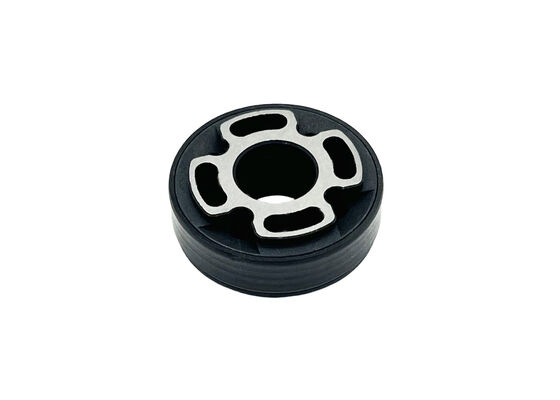
| MOQ: | 1,000pcs |
| Price: | negotiation |
| Standard Packaging: | According to customer’s demand |
| Delivery Period: | Two weeks after payment |
| Payment Method: | T/T,L/C |
| Supply Capacity: | 30,000 pcs per month |
A motorcycle shock absorber piston is more than a mechanical component separating hydraulic chambers. Its structure, oil passages and compatibility with the valve system are important considerations in shock absorber design.
XIAYI manufactures custom motorcycle shock absorber banded pistons for OEM and aftermarket shock absorber applications. Each piston can be developed according to customer drawings, samples and technical specifications, with attention to oil passage configuration, piston geometry, PTFE band structure and assembly requirements.
Our focus is to provide a piston solution that fits the customer's shock absorber design rather than simply supplying a standard component.
Oil passage design is one of the key structural considerations when developing a shock absorber piston.
Different motorcycle shock absorber designs may require different oil hole positions, quantities, diameters and passage configurations. These features need to be considered together with the hydraulic circuit and valve assembly.
XIAYI can manufacture customized piston structures based on customer engineering requirements, including:
The final configuration should be confirmed against the customer's shock absorber design and technical specifications.
The PTFE band is an important part of a banded piston structure. It forms the outer band around the piston body and is designed according to the dimensional and assembly requirements of the shock absorber.
For motorcycle shock absorber applications, the band structure needs to be considered alongside the cylinder dimensions, piston geometry and intended assembly conditions.
XIAYI supports customization of relevant features, such as:
The actual material specification and dimensional requirements can be confirmed during the product development stage.
A piston that looks similar to an existing component is not necessarily interchangeable. Differences in oil passages, external dimensions, band structure and valve assembly interfaces can affect whether a piston is suitable for a particular shock absorber.
XIAYI supports OEM development based on:
This approach helps customers develop a piston that corresponds to their actual shock absorber structure, instead of relying on visual similarity alone.
XIAYI carries out PTFE material preparation and sheet production in-house, followed by the subsequent banding process.
Managing these stages within our own production process allows us to coordinate material preparation, band production and piston processing according to project requirements.
For customers developing new motorcycle shock absorber pistons, material and band-related requirements can be discussed during the quotation and engineering confirmation stages.
For a banded piston, inspection should cover more than the appearance of the finished product.
Depending on the customer's requirements, inspection items can include:
XIAYI can conduct pull-off force testing according to agreed customer requirements. Test methods and acceptance criteria should be confirmed before production.
XIAYI works with customers who need customized shock absorber piston components for motorcycle applications.
Whether you are developing a new shock absorber model, sourcing a replacement piston or evaluating an alternative component, we can review your drawings, samples and technical requirements to determine the appropriate manufacturing solution.
Send us your piston drawing, sample or technical specification to discuss your motorcycle shock absorber banded piston project.
|
Item |
Customization Scope |
|
Application |
Motorcycle front fork and rear shock absorber applications |
|
Piston structure |
Customer-specific piston geometry |
|
Oil passages |
Hole quantity, diameter, position and arrangement |
|
PTFE band |
Band width, thickness and position |
|
Finished dimensions |
Outside diameter and other drawing dimensions |
|
Material |
PTFE material requirements to be confirmed |
|
Inspection |
Dimensional and visual inspection |
|
Testing |
Pull-off force testing according to agreed requirements |
Final specifications depend on the customer's drawings, samples and technical requirements.
A banded piston is a shock absorber piston with a band applied around its outer circumference. In this product structure, the PTFE band is designed in accordance with the piston dimensions and the shock absorber's assembly requirements.
Yes. Oil hole quantity, diameter, position and arrangement can be manufactured according to customer drawings, samples or confirmed technical specifications.
Yes. Customers can provide an existing piston sample for evaluation. Relevant dimensions and structural details should be confirmed before production.
XIAYI carries out PTFE material preparation and sheet production in-house and performs the subsequent banding process as part of its manufacturing workflow.
Yes. Pull-off force testing can be arranged according to customer requirements. The test method and acceptance criteria should be agreed upon before testing.