| MOQ: | Negotiation |
| Price: | Negotiation |
| Standard Packaging: | Standard Export Wooden Case |
| Delivery Period: | 7-15 working days |
| Payment Method: | L/C,T/T |
| Supply Capacity: | 1000 units per month |
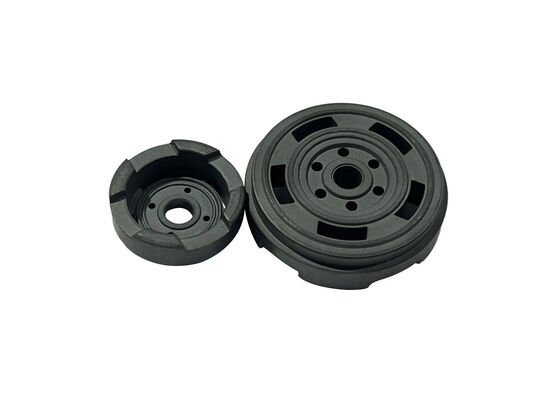
Engineered for consistent damping performance, this high-density shock base valve is manufactured through advanced powder metallurgy with steam treatment, delivering exceptional hardness (HRB70-90) and durability for automotive shock absorber systems.
| Material | Iron base steel / Brass base steel / Custom per drawing |
| Density | 6.5 g/cm3 |
| Hardness | HRB70-90 |
| Surface Treatment | Sand Blasting, Zinc/Chrome Plating, Steam Treating, Painting, Electrophoresis, Powder Coating |
| Part Name | Foot Valve (Shock Base Valve) |
| Dimension | OEM / Customized |
| Certification | IATF16949:2016 |
Sinter foot valve with strong hardness 65HB, manufactured from Fe-C-Cu material for use in automotive shock absorbers. XIA YI produces a wide range of powder metallurgy parts serving automotive, motorcycle, and industrial applications worldwide.
Available MaterialsMixing → Compacting → Sintering → Re-sizing → Ultra Sonic Cleaning → Vacuum Oiling → Packing
All processes are carried out with computer numerical control (CNC) equipment, ensuring precise movement and operation of mills, lathes, and cutting machines.
Our Design CapabilityWe have developed various models of gears, bearings, bushings, and structural parts. Production can be carried out according to your drawings or samples with full engineering support.
Quality Assurance| High-Low Temperature Equipment | Thermal cycle testing for extreme conditions |
| Vibration Test Stand | Simulates real-world vibration environments |
| Durability Test | Long-term wear and fatigue assessment |
| Performance Simulation Bench | In-use condition replication |
| X-Ray Material Testing | Internal defect detection |
| Hardness Testing | HRB scale precision measurement |
| Roughness Testing | Surface finish quality control |
Q1: What is powder metallurgy and why is it used for shock base valves?
Powder metallurgy (P/M) is a manufacturing process where metal powders are compacted and sintered to form high-precision components. For shock base valves, P/M offers superior material consistency, high density, and the ability to create complex geometries that would be difficult or expensive to machine. The Fe-C-Cu material composition ensures excellent wear resistance and mechanical strength, critical for damping performance in automotive shock absorbers.
Q2: What is steam treatment and how does it benefit powder metallurgy parts?
Steam treatment (steam oxidizing) is a surface finishing process where sintered parts are exposed to high-temperature steam. This creates a thin, tightly adherent layer of magnetite (Fe3O4) on the surface, which significantly improves corrosion resistance, seals surface porosity, increases surface hardness, and enhances wear resistance — all without dimensional changes to the part.
Q3: What certifications do you hold for quality management?
We are certified to IATF 16949:2016, the international quality management standard specifically for the automotive industry. This certification demonstrates our commitment to defect prevention, continuous improvement, and reduction of variation throughout the supply chain.
Q4: Can you produce custom dimensions based on our drawings?
Yes, we specialize in OEM production. Simply provide your technical drawings or samples, and our engineering team will develop a tailored manufacturing solution. Our CNC-controlled process ensures precise adherence to your specifications, including custom materials, density requirements, and surface treatments.
Q5: What is your minimum order quantity (MOQ) and typical lead time?
Our MOQ is negotiable based on part complexity and production requirements. Typical delivery time is 7-15 working days after order confirmation. Products are packaged in standard export wooden cases to ensure safe international transit. We accept L/C and T/T payment terms.
Q6: What materials are available for powder metallurgy production?
We offer a comprehensive range of materials including iron base steel, brass base steel, iron-copper alloys, iron-nickel alloys, sinter hardened steel, diffusion alloyed steel, copper infiltrated iron, and various custom alloy formulations. Our team can recommend the optimal material based on your application requirements for strength, wear resistance, and cost efficiency.
Q7: How do you ensure product quality and consistency?
Our quality system includes electronic balance testing for density verification, crush strength testing, X-ray material inspection for internal defects, vibration and durability testing for performance validation, and dimensional inspection using precision measurement tools. Both QC (Quality Control) and PQC (Process Quality Control) teams monitor every production stage to ensure tight tolerances and consistent quality.
| MOQ: | Negotiation |
| Price: | Negotiation |
| Standard Packaging: | Standard Export Wooden Case |
| Delivery Period: | 7-15 working days |
| Payment Method: | L/C,T/T |
| Supply Capacity: | 1000 units per month |
Engineered for consistent damping performance, this high-density shock base valve is manufactured through advanced powder metallurgy with steam treatment, delivering exceptional hardness (HRB70-90) and durability for automotive shock absorber systems.
| Material | Iron base steel / Brass base steel / Custom per drawing |
| Density | 6.5 g/cm3 |
| Hardness | HRB70-90 |
| Surface Treatment | Sand Blasting, Zinc/Chrome Plating, Steam Treating, Painting, Electrophoresis, Powder Coating |
| Part Name | Foot Valve (Shock Base Valve) |
| Dimension | OEM / Customized |
| Certification | IATF16949:2016 |
Sinter foot valve with strong hardness 65HB, manufactured from Fe-C-Cu material for use in automotive shock absorbers. XIA YI produces a wide range of powder metallurgy parts serving automotive, motorcycle, and industrial applications worldwide.
Available MaterialsMixing → Compacting → Sintering → Re-sizing → Ultra Sonic Cleaning → Vacuum Oiling → Packing
All processes are carried out with computer numerical control (CNC) equipment, ensuring precise movement and operation of mills, lathes, and cutting machines.
Our Design CapabilityWe have developed various models of gears, bearings, bushings, and structural parts. Production can be carried out according to your drawings or samples with full engineering support.
Quality Assurance| High-Low Temperature Equipment | Thermal cycle testing for extreme conditions |
| Vibration Test Stand | Simulates real-world vibration environments |
| Durability Test | Long-term wear and fatigue assessment |
| Performance Simulation Bench | In-use condition replication |
| X-Ray Material Testing | Internal defect detection |
| Hardness Testing | HRB scale precision measurement |
| Roughness Testing | Surface finish quality control |
Q1: What is powder metallurgy and why is it used for shock base valves?
Powder metallurgy (P/M) is a manufacturing process where metal powders are compacted and sintered to form high-precision components. For shock base valves, P/M offers superior material consistency, high density, and the ability to create complex geometries that would be difficult or expensive to machine. The Fe-C-Cu material composition ensures excellent wear resistance and mechanical strength, critical for damping performance in automotive shock absorbers.
Q2: What is steam treatment and how does it benefit powder metallurgy parts?
Steam treatment (steam oxidizing) is a surface finishing process where sintered parts are exposed to high-temperature steam. This creates a thin, tightly adherent layer of magnetite (Fe3O4) on the surface, which significantly improves corrosion resistance, seals surface porosity, increases surface hardness, and enhances wear resistance — all without dimensional changes to the part.
Q3: What certifications do you hold for quality management?
We are certified to IATF 16949:2016, the international quality management standard specifically for the automotive industry. This certification demonstrates our commitment to defect prevention, continuous improvement, and reduction of variation throughout the supply chain.
Q4: Can you produce custom dimensions based on our drawings?
Yes, we specialize in OEM production. Simply provide your technical drawings or samples, and our engineering team will develop a tailored manufacturing solution. Our CNC-controlled process ensures precise adherence to your specifications, including custom materials, density requirements, and surface treatments.
Q5: What is your minimum order quantity (MOQ) and typical lead time?
Our MOQ is negotiable based on part complexity and production requirements. Typical delivery time is 7-15 working days after order confirmation. Products are packaged in standard export wooden cases to ensure safe international transit. We accept L/C and T/T payment terms.
Q6: What materials are available for powder metallurgy production?
We offer a comprehensive range of materials including iron base steel, brass base steel, iron-copper alloys, iron-nickel alloys, sinter hardened steel, diffusion alloyed steel, copper infiltrated iron, and various custom alloy formulations. Our team can recommend the optimal material based on your application requirements for strength, wear resistance, and cost efficiency.
Q7: How do you ensure product quality and consistency?
Our quality system includes electronic balance testing for density verification, crush strength testing, X-ray material inspection for internal defects, vibration and durability testing for performance validation, and dimensional inspection using precision measurement tools. Both QC (Quality Control) and PQC (Process Quality Control) teams monitor every production stage to ensure tight tolerances and consistent quality.