| MOQ: | 500pcs |
| Price: | negotiation |
| Standard Packaging: | Standard export packing or as customer's requirement |
| Delivery Period: | Sample Generally 10 Days And Mass Cargo According To Quantity |
| Payment Method: | T/T |
| Supply Capacity: | 50,000pcs per month |
Model SJ-3 | Brand XIAYI | Certification IATF16949:2016
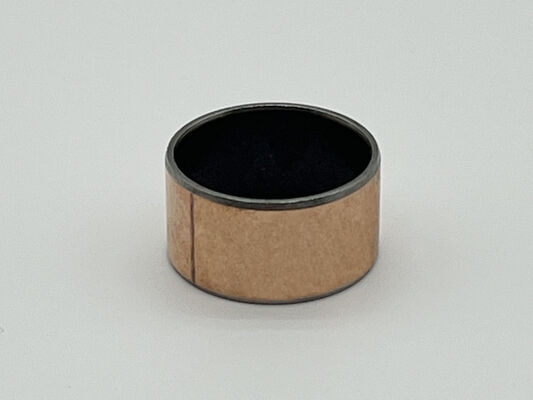
Engineered specifically for automotive shock absorber rod guide applications, the SJ-3 DU bushing combines a PTFE-based sliding surface with precision-ground dimensions to deliver exceptionally smooth rod movement with minimal stick-slip. With concentricity controlled to 0.003mm and grinding accuracy of ±0.005mm, every bushing meets the exacting requirements of modern hydraulic damper assemblies.
| Parameter | Specification |
|---|---|
| Model | SJ-3 |
| Accuracy of Machining | ±0.01 mm |
| Accuracy of Grinding | ±0.005 mm |
| Surface Roughness | Ra 0.8 |
| Parallelism | ±0.005 mm |
| Verticality | ±0.005 mm |
| Concentricity | 0.003 mm |
| Backing Material | Carbon Steel / Stainless Steel (optional) |
| Inner Layer | PTFE + Fibre Compound |
| Interlayer | Sintered Bronze Powder (0.20-0.35 mm) |
| Surface Plating | Bronze-Plating or Tin-Plating |
The SJ-3 DU bushing utilizes a proven three-layer composite architecture that has become the industry standard for maintenance-free plain bearings in automotive suspension systems:
This construction makes the SJ-3 suitable for dry-running conditions with low coefficient of friction, minimal wear rate, and excellent sliding characteristics — essential for the millions of compression-rebound cycles a shock absorber bushing must endure.
Cast Coat Sinter Powder Metallurgy Wrap Forming CNC Finish Grinding Plating
The manufacturing sequence begins with precision strip steel preparation, followed by bronze powder sintering onto the steel surface. PTFE compound is then rolled and bonded into the porous bronze layer under controlled pressure and temperature. Final machining achieves the specified dimensional tolerances before plating and inspection.
Frequently Asked Questions
| MOQ: | 500pcs |
| Price: | negotiation |
| Standard Packaging: | Standard export packing or as customer's requirement |
| Delivery Period: | Sample Generally 10 Days And Mass Cargo According To Quantity |
| Payment Method: | T/T |
| Supply Capacity: | 50,000pcs per month |
Model SJ-3 | Brand XIAYI | Certification IATF16949:2016
Engineered specifically for automotive shock absorber rod guide applications, the SJ-3 DU bushing combines a PTFE-based sliding surface with precision-ground dimensions to deliver exceptionally smooth rod movement with minimal stick-slip. With concentricity controlled to 0.003mm and grinding accuracy of ±0.005mm, every bushing meets the exacting requirements of modern hydraulic damper assemblies.
| Parameter | Specification |
|---|---|
| Model | SJ-3 |
| Accuracy of Machining | ±0.01 mm |
| Accuracy of Grinding | ±0.005 mm |
| Surface Roughness | Ra 0.8 |
| Parallelism | ±0.005 mm |
| Verticality | ±0.005 mm |
| Concentricity | 0.003 mm |
| Backing Material | Carbon Steel / Stainless Steel (optional) |
| Inner Layer | PTFE + Fibre Compound |
| Interlayer | Sintered Bronze Powder (0.20-0.35 mm) |
| Surface Plating | Bronze-Plating or Tin-Plating |
The SJ-3 DU bushing utilizes a proven three-layer composite architecture that has become the industry standard for maintenance-free plain bearings in automotive suspension systems:
This construction makes the SJ-3 suitable for dry-running conditions with low coefficient of friction, minimal wear rate, and excellent sliding characteristics — essential for the millions of compression-rebound cycles a shock absorber bushing must endure.
Cast Coat Sinter Powder Metallurgy Wrap Forming CNC Finish Grinding Plating
The manufacturing sequence begins with precision strip steel preparation, followed by bronze powder sintering onto the steel surface. PTFE compound is then rolled and bonded into the porous bronze layer under controlled pressure and temperature. Final machining achieves the specified dimensional tolerances before plating and inspection.
Frequently Asked Questions