| MOQ: | 1000pcs |
| Price: | negotiation |
| Standard Packaging: | Standard export package |
| Delivery Period: | 30 working days for new samples |
| Payment Method: | T/T,L/C |
| Supply Capacity: | 50,000pcs per month |
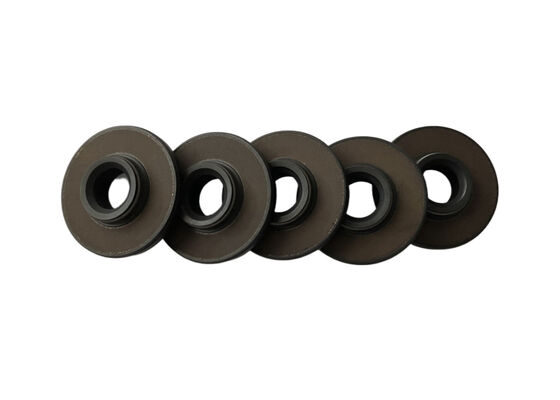
A shock absorber oil seal is a critical sealing component installed around the reciprocating piston rod area of a hydraulic damper. Its primary function is to help retain damping oil while limiting the entry of dust, moisture, and other external contaminants into the sealing area.
In service, an oil seal must work with the piston rod under repeated movement, oil exposure, temperature variation, and assembly tolerances. Incorrect dimensions or unsuitable sealing-lip conditions may contribute to oil leakage, increased friction, or assembly and durability concerns.
XIAYI supplies shock absorber oil seals for automotive, motorcycle, and industrial damper applications. NBR (nitrile rubber) and FKM (fluoroelastomer) material options can be evaluated according to the customer's drawing, installation space, piston rod dimensions, oil type, and operating environment. Key dimensions and sealing-lip condition are included in product inspection.
The oil seal operates at the piston rod sealing position, where repeated movement places demands on the sealing interface. Selection should consider piston rod diameter, surface condition, stroke, and operating frequency rather than relying on the oil seal's external dimensions alone.
NBR and FKM are available as candidate material options for different applications. The final choice should be based on damping oil compatibility, operating temperature, and the actual service environment. Material suitability should be confirmed for each application.
Outer dimensions, width, height, and sealing-lip condition can affect installation and operation. Inspection can cover drawing dimensions, lip integrity, hardness, and appearance to support the customer's assembly and quality requirements.
For different automotive and motorcycle damper designs, oil seal dimensions, materials, and structure can be reviewed against customer requirements. For non-standard parts, customers are encouraged to provide a drawing, sample, or existing part dimensions for technical evaluation.
Parameter |
Specification / Data |
Notes |
Product type |
Shock absorber oil seal |
For reciprocating sealing applications |
Available materials |
NBR / FKM |
Confirm according to oil and media compatibility |
Temperature range |
-40°C to +120°C |
Range stated in existing product information; confirm for the selected material and application |
Outer diameter tolerance |
Existing data records +0 / 0.2 mm |
Tolerance direction and notation must be confirmed against the approved drawing |
Width tolerance |
±0.1 mm |
Subject to the approved product drawing |
Height tolerance |
±0.3 mm |
Subject to the approved product drawing |
Sealing configuration |
Main sealing lip + dust lip |
Confirm the configuration for the selected model |
Inspection items |
Dimensions, lip surface, hardness, appearance, and relevant wear-related checks |
Methods and acceptance criteria should be agreed by both parties |
Applications |
Automotive, motorcycle, and industrial shock absorbers |
Suitability depends on the actual design and operating conditions |
Customization basis |
Customer drawing, sample, installation dimensions, and operating requirements |
Final specifications are subject to technical confirmation |
Automotive suspension dampers: Oil sealing around the reciprocating piston rod.
Motorcycle front forks and rear shock absorbers: Selection based on installation dimensions, damping oil, and operating environment.
Industrial hydraulic damping equipment: Suitability to be assessed against the actual motion, fluid, and temperature conditions.
OEM supply and replacement parts: Specifications can be reviewed using drawings, existing components, or samples to help avoid dimensional mismatches.
To support accurate selection and quotation, please provide:
XIAYI can review the material, dimensions, and structural requirements based on the information provided and confirm the available specifications and sample-evaluation arrangements.
Q1: Can the oil seal be supplied in NBR or FKM?
NBR and FKM can be considered as candidate materials. The final selection depends on damping oil compatibility, operating temperature, and the actual service environment.
Q2: Can an oil seal be customized from an existing part or sample?
An existing part or sample can be used as a reference for evaluation. A drawing, mating piston rod dimensions, and operating conditions will help confirm the required dimensions and material.
Q3: Which dimensions should be confirmed before ordering?
Key dimensions typically include inner diameter, outer diameter, width, height, and sealing-lip configuration. The mating piston rod and installation space should also be checked. Tolerances should follow the approved drawing.
Q4: Can test data be provided?
Dimensional inspection, material verification, and sealing-performance tests can be discussed according to project requirements. Any report, acceptance criteria, or test conditions must reflect the tests actually performed and the records available.