| MOQ: | 1000pcs |
| Price: | negotiation |
| Standard Packaging: | Standard export package |
| Delivery Period: | 30 working days for new samples |
| Payment Method: | T/T,L/C |
| Supply Capacity: | 50,000pcs per month |
The fit dimensions and sealing contact condition of an oil seal are important considerations in shock absorber assembly. For automotive and motorcycle suspension manufacturers, selecting the right oil seal involves more than checking its outer diameter and width. Inner diameter, sealing-lip configuration, mating piston rod dimensions, and operating conditions should also be considered.
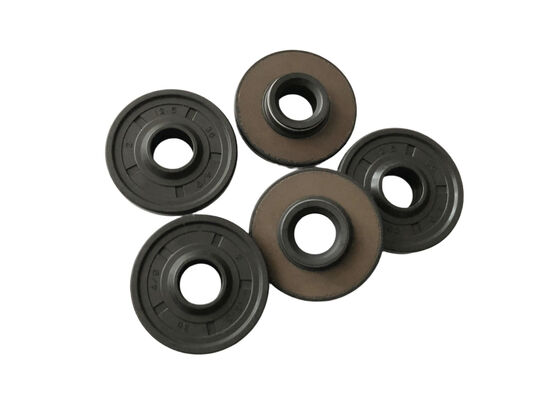
XIAYI supplies shock absorber oil seals for automotive, motorcycle, and industrial applications. Product specifications can be evaluated against customer drawings, physical samples, and installation requirements. NBR (nitrile rubber) and FKM (fluoroelastomer) are available as material options, subject to application requirements and technical confirmation.
The products can be considered for OEM development, replacement applications, and non-standard dimensional requirements. Confirming drawings, tolerances, and operating conditions before ordering helps reduce specification discrepancies and assembly-fit risks.
The outer diameter, width, height, and inner diameter must be reviewed against the installation space and mating components. For different damper designs, critical dimensions and tolerances should be confirmed using the approved drawing rather than relying on visual similarity.
The sealing lip forms an important part of the contact interface between the oil seal and the mating component. Inspection can focus on visible lip condition, dimensional conformity, and any defects that may affect acceptance against the agreed requirements.
NBR and FKM can be considered for different applications. Final material selection should account for damping oil compatibility, operating temperature, and the service medium. For applications with demanding temperature or media requirements, material suitability should be confirmed before volume purchasing.
For OEM projects with defined assembly dimensions, specifications can be reviewed against formal drawings. For replacement applications, an existing component or sample can serve as a reference. Providing mating piston rod data and operating conditions can further support technical evaluation.
|
Parameter |
Specification |
Notes |
|
Product |
Shock Absorber Oil Seal |
For suspension and damper assemblies |
|
Material options |
NBR / FKM |
Confirm the material required for the application |
|
Reference temperature range |
-40°C to +120°C |
Listed in existing product information; confirm for the selected material and model |
|
Outer diameter tolerance |
Existing data records +0 / 0.2 mm |
Sign convention and tolerance direction require drawing confirmation |
|
Width tolerance |
±0.1 mm |
Subject to the approved drawing |
|
Height tolerance |
±0.3 mm |
Subject to the approved drawing |
|
Sealing-lip configuration |
Main sealing lip + dust lip |
Confirm according to the selected model |
|
Main inspection items |
Dimensions, lip surface, hardness, appearance, and relevant wear-related checks |
Inspection criteria to be agreed with the customer |
|
Applications |
Automotive, motorcycle, and industrial shock absorbers |
Suitability depends on design and operating conditions |
|
Specification review |
Drawing, sample, and assembly parameters |
Non-standard specifications require technical confirmation |
Oil seal quality should be assessed against the dimensional and application requirements of each project. The following items can be included in the inspection plan:
Dimensional inspection: Verify critical dimensions against the approved drawing.
Sealing-lip appearance: Check the sealing contact area for visible damage or irregularities.
Material confirmation: Confirm NBR, FKM, or other agreed material requirements.
Batch acceptance: Establish the agreed sampling or full-inspection plan and required inspection records.
Assembly validation: For critical applications, evaluate samples with the mating piston rod and installation structure.
Inspection items, sampling ratios, and acceptance criteria should be documented in the purchase order or technical agreement to align supply specifications with assembly requirements.
|
Application |
Key Items to Confirm |
|
Automotive suspension dampers |
Installation dimensions, mating piston rod, and operating environment |
|
Motorcycle front forks |
Seal dimensions, mating components, and service conditions |
|
Motorcycle rear shock absorbers |
Installation space, sealing configuration, and oil compatibility |
|
Industrial damping equipment |
Service medium, temperature, and motion type |
|
OEM volume supply |
Approved drawings, tolerances, material, and batch acceptance criteria |
|
Replacement parts |
Existing dimensions, sample condition, and assembly requirements |
To support specification review and quotation, please provide:
Based on this information, XIAYI can review the dimensional, material, and structural requirements and discuss specification compatibility, sample evaluation, and volume-supply requirements.
Q1: Can shock absorber oil seals be supplied according to customer drawings?
Specifications can be evaluated against customer drawings and technical requirements. Critical dimensions, tolerances, material, and sealing configuration should be confirmed before production.
Q2: How can I check whether an oil seal fits an existing shock absorber?
Review the seal dimensions, mating piston rod parameters, installation space, damping oil, and operating temperature together. A similar appearance or matching outer diameter alone does not guarantee correct fit.
Q3: How should I choose between NBR and FKM?
Suitability depends on damping oil compatibility, temperature, and the service medium. The final selection should be based on the actual application rather than the material name alone.
Q4: Can samples be evaluated before volume purchasing?
Drawings or samples can be provided for technical review. For projects with tight dimensional requirements, confirm critical dimensions and assembly compatibility before volume production.